Introduction
Latrodectus is a malware loader for Windows: it installs itself on a machine, reports to its command-and-control (C2) servers, and downloads and runs what its operators send. Human malware analysts have published eight reverse-engineering analyses of it. This post sets those analyses side by side with what Malspark's AI agents established about one Latrodectus sample in a single run.
The introduction and the comparison method need no reverse-engineering background. The sections from the string cipher to persistence follow the sample's code address by address, for readers who want to check each statement.
One run of the platform on one Latrodectus DLL, the reference run, was scored against the key, a set of 89 checkable facts drawn from eight published analyses by human researchers. The run recovered 84 of them, 56 in full and 28 in part, and none was scored wrong. Its report also states 37 verified facts that the key does not contain, called beyond the key below, each proved by an entry in its evidence ledger. Of the 37, 11 are in none of the eight analyses: two readings of each analysis's text and a reading of every figure found no part of them. For each of the other 26, an analysis states or shows part of the fact and the run adds the rest: the code that performs a described behaviour, or an exact value.
The run comes from Malspark, a self-hosted platform. Its triage pack runs capa, FLOSS and YARA
without a model, and a team of AI agents works with Ghidra, radare2, the
sandbox report, the packet capture and reputation lookups. The agents argue
the findings out in a debate, and a judge decides. Every factual sentence of
the report carries numbered citations into the evidence ledger, the log
of every tool call with its arguments and answer. Each call is one ledger
entry, named ev_ plus a number; an ev_ id after a statement below names
the entry that proves it. The reference run took 129 model calls and 84
minutes, and cost 8.24 USD at list prices.


The reference run's output is published: the report, in Markdown and HTML, the evidence bundle, the evidence ledger with its 149 entries, the STIX 2.1 bundle and the ATT&CK mapping.
To follow one claim, go from the report sentence to its numbered note, from
the note to the bundle, and from the bundle to the ledger entry and the tool's
answer. The cipher sentence in section 5.1 of the report, "For the seed
0x33629d40 the first key is 0x41", carries note 39, which leads to ev_0021
and ev_0089. For the raw bytes behind the 12345 example in the string cipher section
below, open ev_0087.
The published copies are defanged, so the digests in the ledger no longer
match them. A rerun of the job gives you a sealed ledger of your own, and
GET /api/v1/jobs/{job_id}/evidence/verify checks its keyed chain against the
seal. The sample is available by its hash from MalwareBazaar or VirusTotal.
The sections below set what the published analyses say next to what the run established, down to addresses, constants and decoded bytes, with the ledger entry for each value. Then come the points where the analyses differ and the facts beyond the key. The post ends with Side by Side: Every Fact, One by One, a table row for each fact with what each of the eight analyses states about it.
Comparison Method
The key is drawn from these eight published analyses, listed by date:
- Proofpoint, Latrodectus: This Spider Bytes Like Ice, Proofpoint Threat Research and Team Cymru S2 Threat Research, 4 April 2024.
- 0x0d4y, Latrodectus [IceNova], 30 April 2024.
- Elastic Security Labs, Spring Cleaning with LATRODECTUS: A Potential Replacement for ICEDID, Daniel Stepanic and Samir Bousseaden, 16 May 2024.
- Pulsedive, Latrodectus Loader, 4 June 2024.
- Bitsight, Latrodectus, are you coming back?, João Batista, 17 June 2024.
- RevEng.AI, Latrodectus Affiliate Resumes Operations Using Brute Ratel C4 Post Operation Endgame, 24 June 2024.
- Krakz, Latrodectus dropped by BR4, 1 August 2024.
- Cy83rTr0n, Latredocus Exposed: Unraveling the New Cyber Threat, undated.
Thanks go to the authors of these eight analyses for publishing their work: this comparison is possible only because they shared it.
The key holds the checkable facts these eight analyses state in their text and their figures, 89 in all, in ten groups from identity to ATT&CK techniques. The benchmark page explains how the key is built and scored and states the method's limits, and it lists every verdict and every fact beyond the key.
The run is blind to the key. No analysis is given to the agents; they start with an empty long-term memory and use the all-tools team. Two scorers independently marked each fact found, partly found, missed or wrong, and checked every verdict against the evidence ledger, not the report text alone. A fact counts as beyond the key only when the report body states it, no key item holds it, and a ledger entry proves it.
The sample ran in a real sandbox. The run's records hold no DNS or HTTP session to either C2 name, so the protocol, commands and persistence below are read from the decompiled code.
The analysts describe a family across samples and versions, in prose and
figures, and several of them read other builds. Proofpoint describes the
family across versions, Elastic and Krakz each analyse another sample with
the same campaign string, and RevEng.AI covers versions 1.1 to 1.3. The run
reads one build: the 60,928-byte x86-64 DLL with sha256
6091f2589fef42e0ab3d7975806cd8a0da012b519637c03b73f702f7586b21ef. Its C2
domains, group name and RC4 key are checked against the analyses and not
counted as new. Other values of this one file, such as the sandbox process
tree, the VirusTotal result and the number of encoded texts, count among the
37.
Addresses here are offsets from the image base; the ledger adds the load
base, so 0xae78 is 0x1360bc0ae78 there.
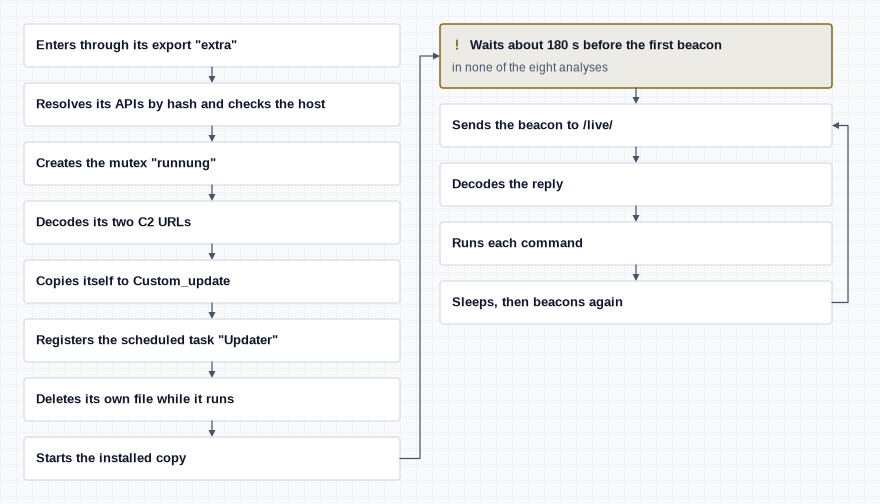
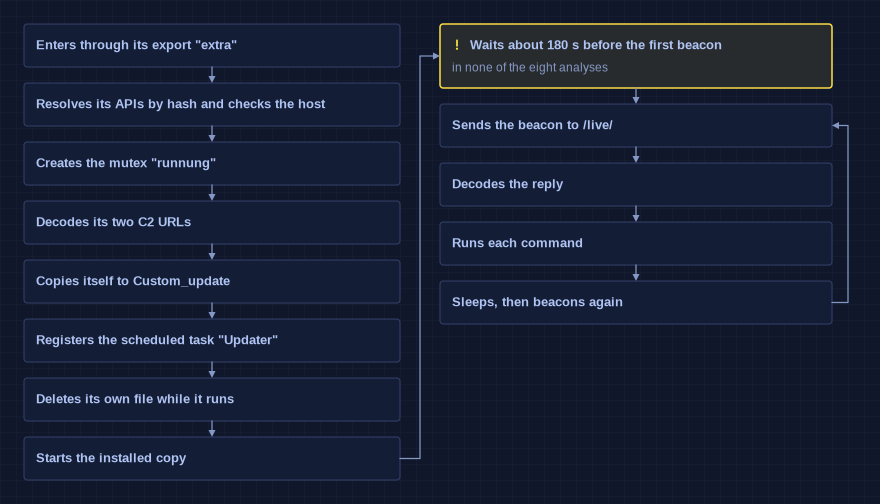
The flow below starts at extra, one of the DLL's four exports, which calls
0x3cb4, and 0x3cb4 calls the main routine 0x3868 ev_0081 ev_0077.
The Agent Team and Its Configuration
The pipeline first runs the triage pack. The triage agent reads its facts and decides what the team should look at. Three static analysts then work in parallel, the reverser takes their findings into Ghidra, and the dynamic and network analysts read the sandbox report and the capture, each stage with the earlier findings in hand. The debate, the judge's verdict and the report follow. Every agent ran on Claude Haiku 5.5 through the Anthropic API, with adaptive thinking.
| Agent | Task | Tools it could use | Effort | Model calls |
|---|---|---|---|---|
Triage, triage | reads the pack's facts first and decides what the team should look at | analysis and knowledge servers, reputation lookups | high | 14 |
Static analyst, static | reads the file through the analysis tools | analysis and knowledge servers, reputation lookups | high | 13 |
Static analyst on radare2, all_tools_static_r2 | reads the file through radare2 and the analysis tools | radare2 through r2mcp, analysis and knowledge servers | high | 11 |
Static analyst on Qu1cksc0pe, all_tools_qu1cksc0pe | runs a third-party static analyser and reports what its output supports | the Qu1cksc0pe server | high | 9 |
Reverser on Ghidra, all_tools_reverser_ghidra | takes each static finding into the decompiler and confirms or refutes it at function level | Ghidra through Ghidra MCP, knowledge server, VirusTotal | high | 23 |
Dynamic analyst, dynamic | reads the sandbox report: processes, files, registry, signatures | the sandbox report, knowledge server | high | 6 |
Network analyst, network | reads the capture and the sandbox's network record | network server for the capture, knowledge server, reputation lookups | high | 5 |
Judge, judge | mediates the debate and states the verdict | the evidence ledger, knowledge server, reputation lookups, the sandbox report, and tasks handed to the built-in reverser or the static analyst | high for the verdict, medium for mediation | 12 |
Reporter, reporter | writes the report | none | medium | 36 |
The analysis server reads the file's structure, strings and indicators and offers YARA, capa and FLOSS; the knowledge server holds ATT&CK, an API-behaviour catalogue and family and prior-case retrieval. Reputation lookups went to VirusTotal's own MCP server. Hatching Triage's cloud sandbox detonated the sample within the 600-second run limit it set for the task. The debate reached consensus after three rounds.
To carry this set-up elsewhere, use the console: Settings → Configuration → Export configuration
downloads every setting changed from its default as one JSON document, with
the agents, teams, per-agent models and tool servers among them, and
Import configuration previews such a document before applying it. The API offers the same through
GET /api/v1/settings/export and POST /api/v1/settings/import. No
credential is ever exported: the document names each one it leaves out.
The all-tools team ships as such a document,
all-tools.json. It defines the team's
stages and its three all_tools_ agents; the other six are built into the
platform. The configuration guide
shows how to merge the file into your own export and what the team needs beside it: the
Qu1cksc0pe server, Ghidra and radare2. Models and effort levels are set per
agent in the model overrides,
not in the file; this run used the values in the table above.
For the reference run, how much each agent read and wrote is in the figure below. Input is everything a model reads on one call: the agent's instructions, the definitions of its tools, the evidence it is handed and every tool result it has gathered so far. That is why the two agents with the most calls lead, the reverser with 23 and the reporter with 36. Of the run's 19.9 million input tokens, 12.2 million came from the provider's prompt cache, and the agents wrote 1.5 million tokens of output.
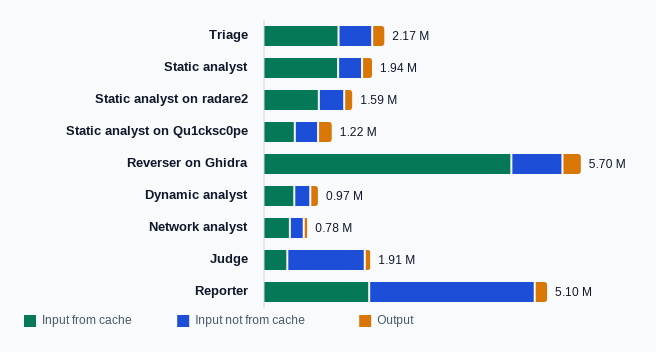
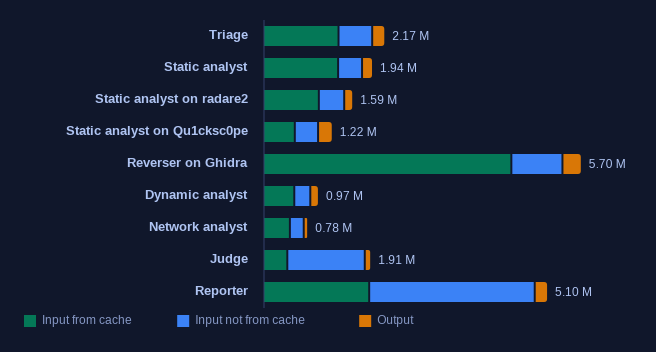
The cached part is long because of how a tool loop works. From an agent's second call on, most of its input is the record of its earlier calls, which the provider already holds, so only what the last tool answer added is new. The reverser read 83% of its input from the cache: its first call, 123 thousand tokens, all new, cost 0.11 USD, and its second, 125 thousand tokens with 123 thousand from the cache, cost 0.009 USD. The other analysts read 58% to 76% from the cache. The reporter and the judge read less, 39% and 24%, because their work is not one growing loop: the reporter's section calls share an opening of about 60 thousand tokens and then differ from section to section, and the judge starts a new record at each debate round and at the verdict.
The String Cipher, Byte by Byte
Latrodectus stores its strings, the C2 addresses among them, encrypted in the file and decodes them as it runs, which keeps them out of a plain string search. This section follows that cipher, from the published descriptions to the decoder in this sample.
Bitsight writes: "All encrypted strings start with a 6 byte long header. The
first 4 bytes contain the initial XOR seed and the next 2 bytes contain length
of the XOR-encrypted string." For the latest version it adds that "now the
seed is incremented by 1 at every iteration." Proofpoint describes the same
change: "the PRNG was replaced by an increment of the seed variable", which
makes "a rolling XOR key". Elastic gives the algorithm in Python, with the key
for byte i as (x + i + 1).
RevEng.AI prints the layout as a structure, a 4-byte dwKey and a 2-byte
wSeed, and notes that "the actual size of the obfuscated string is derived
from the XOR operation of the wSeed and dwKey fields". Krakz draws the same
layout, and its configuration extractor finds the strings by their shared
first four bytes, "the starting buffer with the most occurrences". Cy83rTr0n
writes the key for byte i as (xor_key + index + 1) AND 0xFF.
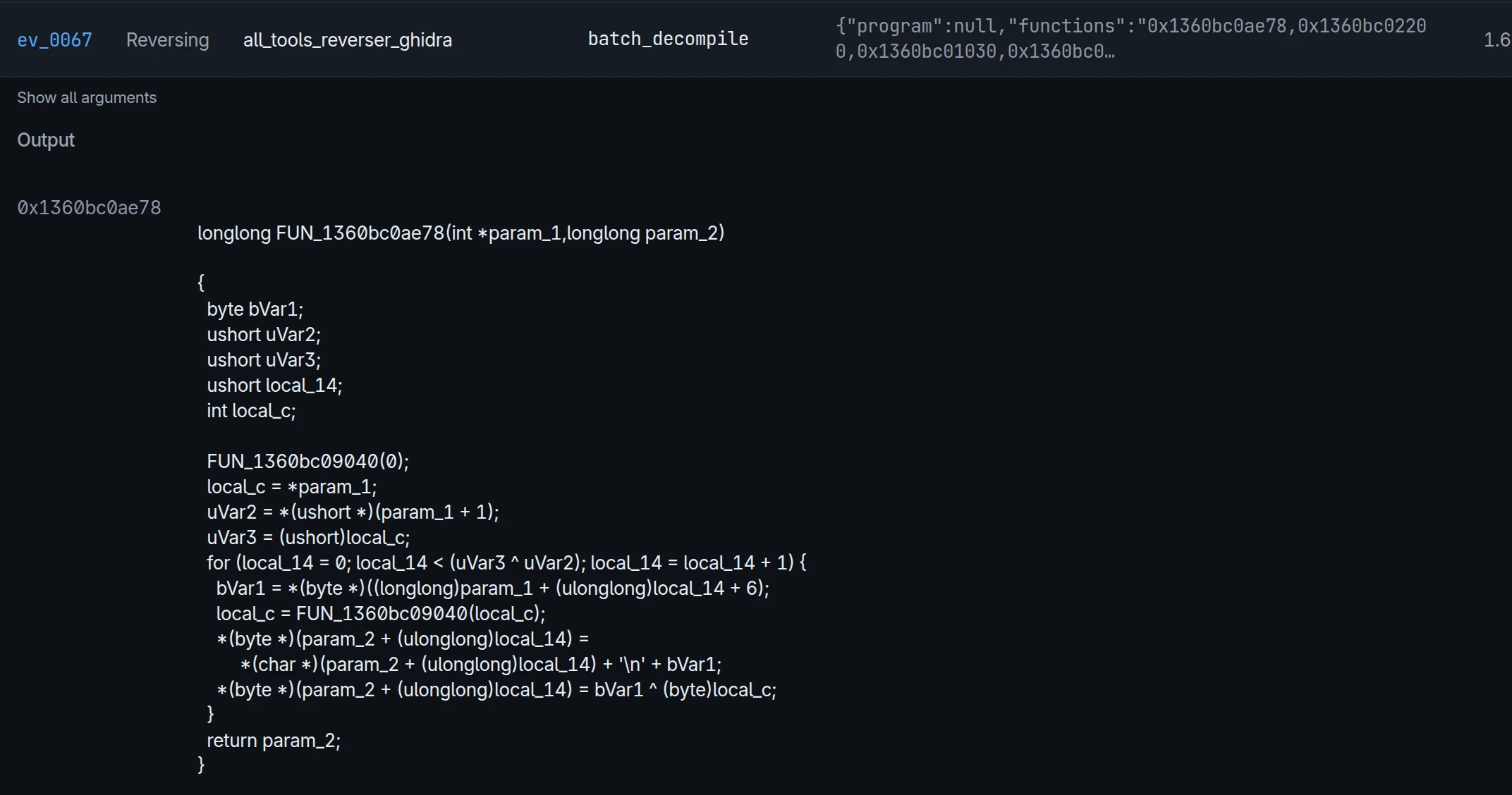
In the reference run, the decoder is the routine at 0xae78. Ghidra's
decompiles of it and of its helper 0x9040, whose body is
return param_1 + 1;, reduce to this ev_0067 ev_0068:
seed = *(uint32_t *)blob;                        /* local_c = *param_1          */
len  = *(uint16_t *)(blob + 4) ^ (uint16_t)seed; /* uVar3 ^ uVar2               */
for (i = 0; i < len; i++) {
    seed = seed + 1;                             /* FUN_...09040(local_c)       */
    out[i] = blob[6 + i] ^ (uint8_t)seed;        /* bVar1 ^ (byte)local_c       */
}
It is the same scheme as Elastic's Python. With this build's seed, the
platform's own decoder reads 101 blobs, and 90 of them are also among the
strings FLOSS emulation recovers ev_0021 ev_0019. All of them start with
the same four bytes, 40 9d 62 33, and the report's YARA draft uses them as
its marker string. In the file Krakz read, the decoder at 0x18000AE78 and
the :wtfbbq blob at 0x18000FA18 sit at the same offsets as this file's
0xae78 and 0xfa18 ev_0021.
This is why the cipher matters: the plain-text strings carry no network or host indicator. The URLs, paths and command lines sit behind this routine, and the API names behind CRC-32 hashes.
The worked example uses the raw bytes at 0xfd30, as Ghidra read them
ev_0087:
bytes   40 9d 62 33 | 46 9d | 70 70 70 70 70 46
        seed 0x33629d40       length 0x9d46 ^ 0x9d40 = 6
key     41 42 43 44 45 46
plain   31 32 33 34 35 00     "12345"
12345 is the RC4 key. The blob's only reference is at 0x57d0, inside the
beacon routine 0x5750, which passes it to 0xae78 ev_0021 ev_0067.
The static analyst re-ran the decryption itself with a byte-transform tool.
With the 6-byte header dropped, it recovered the first C2 URL,
hxxps://titnovacrion[.]top/live/, which matches the platform decoder
ev_0050 ev_0021.
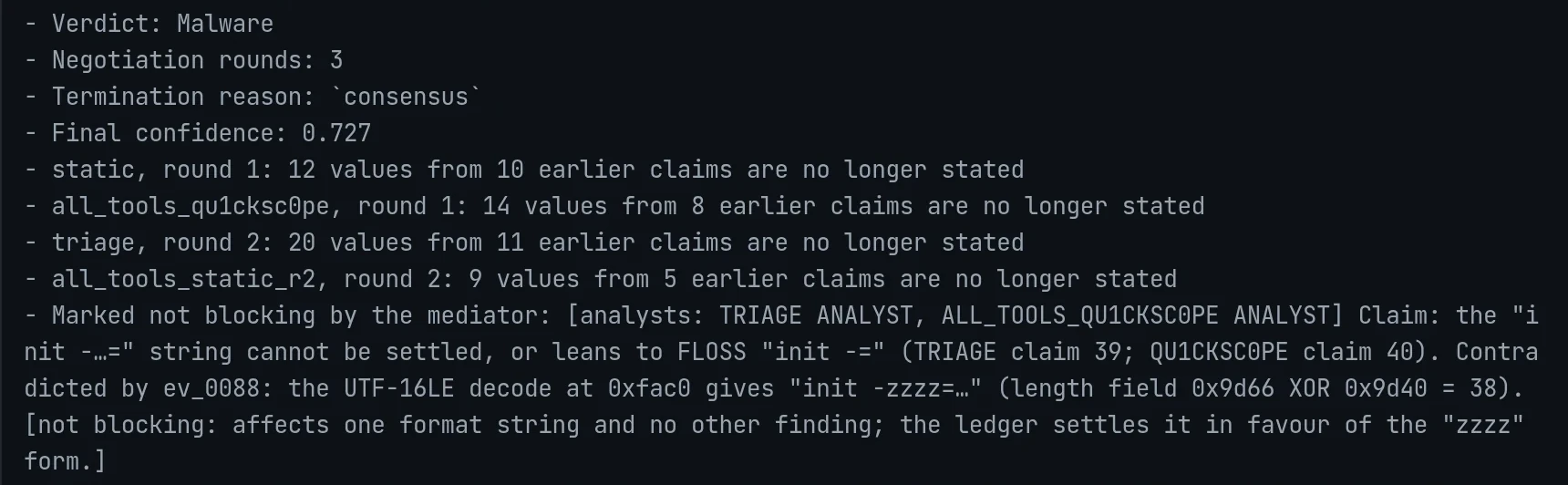
A debate then settled one string. FLOSS rendered the text decoded at the call
at 0x4571, from the blob at 0xfac0, as init -="%s\%s" ev_0019. Two
analysts left the string open or favoured that form. The reverser read the
raw bytes at 0xfac0 ev_0088. Their header gives a length of
0x9d66 ^ 0x9d40 = 38 bytes, 18 characters and a terminating zero in
UTF-16LE; init -="%s\%s" fills only 30 of them, which leaves room for four
more characters. The mediator recorded: "Contradicted by ev_0088: the
UTF-16LE decode at 0xfac0 gives "init -zzzz=…"", and "the ledger settles it in
favour of the "zzzz" form." The full string init -zzzz="%s\%s" is what
0x4110 later passes to the rundll32 launcher.
API Resolution by CRC-32
Latrodectus does not call Windows functions by name. It finds each one at run time by comparing CRC-32 checksums of module and function names, so the code holds checksums where another program would hold the names. This section follows that resolver in the analyses and in this sample.
Bitsight writes that the loader "compares the CRC32 hash value of each Unicode name string with the target value", and that "All necessary Windows APIs are resolved at the beginning of execution." Elastic writes that "it queries the PEB in combination with using a CRC32 checksum to resolve kernel32.dll and ntdll.dll modules and their functions."
RevEng.AI gives the values: Latrodectus walks "the InMemoryOrderModuleList
found within the PEB to first retrieve the addresses of loaded ntdll.dll
(0x26797E77) and kernel32.dll (0x2ECA438C) modules", and its API table "is
built sequentially during the initialisation phase", with entries such as
NtAllocateVirtualMemory 0xE0762FEB and RtlGetVersion 0xB46508B5. Krakz
prints the table entry as a structure: function hash, module-handle pointer,
function pointer. Pulsedive describes how further DLLs are found: the malware
"searches for all DLLs in the Windows system directory, gets the filename and
then computes the CRC32 checksum value", and loads a match with LoadLibraryW.
Apart from its five imports ev_0004, the DLL resolves everything at run
time, as the reference run shows:
0x8690reads the PEB throughGS:[0x60]. The resolver0x869cwalks a module's export names, hashes each with0x6aa4and returns the first matchev_0024ev_0068.- The bit-reversed CRC-32 polynomial
0xedb88320sits at RVA0x6b0cinside0x6aa4, found byfind_crypto_constantsev_0023. capa tags the same routine "hash data with CRC32"ev_0008. resolve_api_hashesmatches 164 stored values to names: 154 functions from 11 DLLs and 10 module namesev_0020. RevEng.AI's four values are among them:0x2eca438cfor kernel32.dll in0x84e4,0x26797e77for ntdll.dll in0xabd4, and0xe0762febfor NtAllocateVirtualMemory and0xb46508b5for RtlGetVersion at0xa5a7and0xa5c7in0xa59c.- Six hash tables hold 163 of the 164 values. By address, they are:
0x84e4, kernel32 module names;0x904c, WinINet, urlmon, shell32, advapi32, shlwapi, iphlpapi and user32;0x9484, kernel32 process, thread, memory, file and pipe;0xa47c, module names;0xa59c, ntdllNt*,Rtl*andLdrLoadDll;0xac50, ole32. Hash sites include CreateToolhelp32Snapshot at0x94efand GetAdaptersInfo at0x93eb. - The function index then wires slots to callers
ev_0025. - Alongside the resolution,
0x3868checks the host, as Bitsight and Elastic describe: a PEB BeingDebugged read in0x3074and0x309c, an OS-version check in0x8560, a process-count check in0x8820and a network-adapter check in0x68e8ev_0069ev_0082ev_0086.
What each hash table holds is what a code-level YARA rule or a disassembler script needs; the resolver-tables row of the tables records it.
Configuration and the C2 Protocol
Once installed, Latrodectus registers with its C2 server and then asks it for work at intervals. This section covers the sample's configuration (its C2 addresses, RC4 key and group name), what a request carries and how a reply is read.
Bitsight writes that "Latrodectus uses POST requests over HTTPS to register
itself with the C2 servers", that it
"always uses Mozilla/4.0 (compatible; MSIE 7.0; Windows NT 5.1; Tob 1.1) as
the user agent string, and the requests are always sent to the /live/
endpoint." The body "is RC4 encrypted with the key 12345 and base64
encoded", and so is the reply. Bitsight adds that "Latrodectus sends requests
at intervals ranging from 7.5 to 10 minutes." Proofpoint lists the four reply
verbs: CLEARURL, URLS, COMMAND and ERROR. Elastic shows the header
Content-Type: application/x-www-form-urlencoded in a captured request, and
Pulsedive and Cy83rTr0n print it too.
0x0d4y names InternetConnectA and HttpSendRequestA as the calls that carry the
traffic, and writes that if the connection fails, "it will perform the same
procedures with the second C2". Krakz writes that "The RC4 key is stored
obfuscated using the same obfuscation as other strings", and it decrypts a
reply whose lines read URLS|0|… and COMMAND|4|front://sysinfo.bin.
Pulsedive notes that the key 12345 "has been reused across different
samples".
The reference run traces these steps, in the order the code runs:
0x6988decodes blobs0x10250and0x10278into a two-entry table:hxxps://titnovacrion[.]top/live/andhxxps://skinnyjeanso[.]com/live/. The beacon cracks each entry with InternetCrackUrlA at0x52c4and moves to the next on failureev_0021ev_0067ev_0082.0x5750fills the templatecounter=%d&type=%d&guid=%s&…&direction=%s, decoded at0xfd40, encrypts it with RC4 in0xcbe0,0xca08and0xcaac, and base64-encodes it with0x6634.0x4c70opens the session. The user agent is argument 1 of InternetOpenW at0x4cb0.0x5030sends POST when its second argument is nonzero and GET otherwise, with the Content-Type header Elastic shows, decoded here at0xfb68. For an HTTPS URL it sets InternetSetOptionA option0x1fto0x4380ev_0069.0x4f58reads the reply in 255-byte chunks,0x6370base64-decodes it, RC4 decrypts it, and0x541cparses CLEARURL, URLS and COMMAND.0xd1c8stores the URL table asURLS|%d|%slines inupdate_data.dat.- The timing comes from the
0x5750listing inev_0067:
for (local_2cc = 0; local_2cc < 0x708; local_2cc = local_2cc + 1) {
    FUN_1360bc0c934(100);                              /* 1,800 x 100 ms     */
}
...
uVar4 = FUN_1360bc088a4();
local_294 = ((int)((uVar4 & 0xffffffff) % 0x96) + 0x1c2) * 1000;   /* 450-599 s */
if (DAT_1360bc1058c != 0) {
    uVar4 = FUN_1360bc088a4();
    local_294 = ((int)((uVar4 & 0xffffffff) % 600) + 0x5dc) * 1000; /* 1,500-2,099 s */
}
The first beacon waits about 180 s, which sets a sandbox timeout and a hunting window. After that, a pseudo-random value sets each wait to 450 to 599 s, the 7.5 to 10 minutes Bitsight gives. Once command 19 has set the long-sleep flag, each wait is 1,500 to 2,099 s, Bitsight's 25 to 35 minutes after a C2 command.
For the session that 0x4c70 opens, the reverser disassembled the routine and read the arguments of InternetConnectA
from the stack stores ev_0097. The report explains why: "The decompiler
listing shows only the first argument of that call, which is why the server
and port looked unresolved; the disassembly carries them."
1360bc04cc5: MOV qword ptr [RSP + 0x38],0x1     ; dwContext 1
1360bc04cce: MOV dword ptr [RSP + 0x30],0x0     ; dwFlags 0
1360bc04cd6: MOV dword ptr [RSP + 0x28],0x3     ; dwService 3, HTTP
1360bc04cde: MOV qword ptr [RSP + 0x20],0x0     ; password NULL
1360bc04ce7: XOR R9D,R9D                        ; user name NULL
1360bc04cea: MOVZX R8D,word ptr [RSP + 0x70]    ; port
1360bc04cf0: MOV RDX,qword ptr [RSP + 0x68]     ; server
1360bc04cf5: MOV RCX,qword ptr [RSP + 0x40]     ; session handle
1360bc04cfa: CALL qword ptr [0x1360bc10e08]     ; InternetConnectA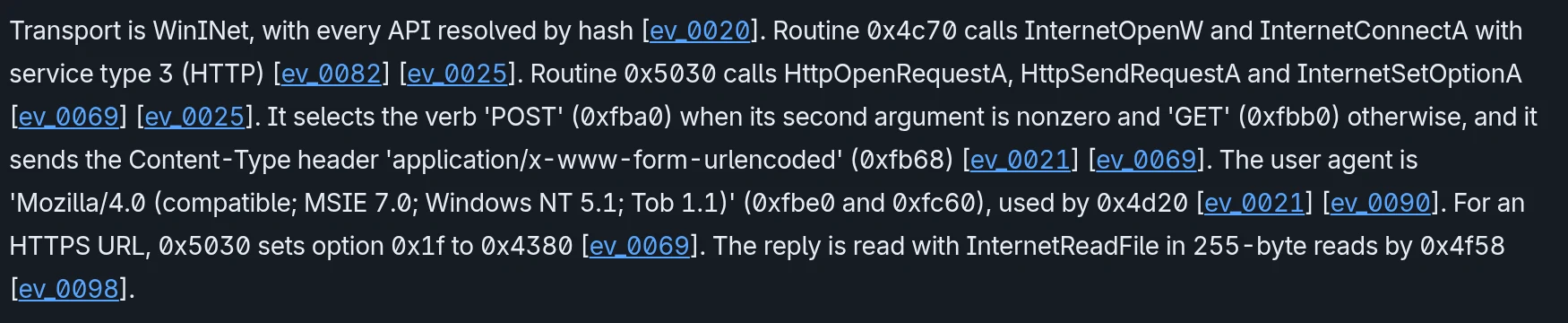
The group string behind the group ID, decoded by the run at 0xfb10, is
Littlehw, hashed by the FNV routine 0xc99c ev_0021 ev_0069 ev_0023.
Bitsight and Proofpoint describe the hash as FNV-1a, and Krakz writes FNV-1.
FNV-1a of that string is 510584660, the group ID that Bitsight's campaign
table lists for Littlehw.
The Command Dispatcher
A reply from the C2 server can carry numbered commands, from listing the files on the desktop to downloading and running a further program. This section follows the routine that hands each command to its code.
Bitsight's command table runs from 2 "Collect desktop filenames" to 21
"Download and execute stealer module". It lists 13 as "Download and execute
DLL file via rundll32" and 18 as "Download and execute Anubis aka IcedID".
Elastic, Proofpoint, Pulsedive and Krakz each list eleven ids from 2 to 20,
with their own descriptions. Krakz gives 18 as "Run DLL in AppData (init -zzzz
files/bp.dat)". Cy83rTr0n's FLOSS list holds the file-name formats %s%d.exe,
%s%d.dll and %s\%d.dll and the launcher
C:\WINDOWS\SYSTEM32\rundll32.exe %s,%s. Their descriptions of ids 14 and 21
differ; a later section compares them with this sample's code.
Every command, the run shows, enters through one chain: 0x5750 calls
0x541c, which calls the dispatcher 0x3cf4, and each is the only caller of
the next ev_0078 ev_0083, so a hook on 0x541c sees every command that
arrives through the reply parser. The switch in 0x3cf4 has twelve cases
ev_0077. It compares ids in hex, so 0x12 and 0x15 are wire ids 18 and
21:
| Id | Case | Routine | What the code does |
|---|---|---|---|
| 2 | 0x2 | 0x1a08 | lists the desktop folder into &desklinks=[ |
| 3 | 0x3 | 0x1c38 | walks a process snapshot into &proclist=[ |
| 4 | 0x4 | 0x2118 | starts thread 0x2200, which runs the discovery command lines through 0x1030 |
| 12 | 0xc | 0x6e04 | downloads %s%d.exe and starts it |
| 13 | 0xd | 0x6c2c | downloads %s%d.dll and starts it through rundll32 |
| 14 | 0xe | 0x7170 | runs the download from memory on thread 0xb398 |
| 15 | 0xf | sequence | self-update, below |
| 17 | 0x11 | ExitProcess | ends the process |
| 18 | 0x12 | 0x4110 | fetches files/bp.dat and launches through 0xb4cc |
| 19 | 0x13 | flag DAT_1058c | long sleep |
| 20 | 0x14 | flag DAT_10590 | counter reset |
| 21 | 0x15 | 0x72c8 | runs the download in memory on thread 0xb670 |
Three cases deserve a closer look:
- In command 13, case
0xd,0x6c2cwrites the download as%s%d.dllunder shell folder0x1c, Local AppData.0xb4ccthen formatsC:\WINDOWS\SYSTEM32\rundll32.exe %s,%s, the string at0xfe90, and calls CreateProcessWev_0069ev_0021. A command-line rule can use that format directly. - Commands 14 and 21 are cases
0xeand0x15. Case 14 copies the download into a VirtualAlloc buffer, and case 21 into one from the NtAllocateVirtualMemory wrapper0xad34, both with protection0x40ev_0081ev_0068. Neither writes the download to disk. - Command 15, case
0xf, is the self-update. In the code's order,0x6e04fetches%s%d.exewithout launching it,0x3c2ccloses handles,0x3a24renames the running image and sets delete-on-close,0x3808deletes the install copy, and the routine starts the new copy and exits. Elastic describes the same sequence: "The file is subsequently deleted and a new binary is downloaded/executed before terminating the existing process."
Before seven of the cases, an argument longer than 8 characters that begins
with the decoded front is rewritten as the current C2 URL up to its first
single slash, the decoded /files/ and the rest of the argument. Proofpoint
describes this step: "with the string “/files/” appended". Bitsight writes
that front:// is "included to be replaced with
https://<current C2 domain>", and Krakz replaces it with the C2 URL.
Persistence and Self-Deletion
To survive a restart, Latrodectus copies itself into the user's profile and registers a scheduled task that starts the copy at every logon, and it deletes the file it was started from. This section follows both steps.
Bitsight writes that the sample copies itself to
%appdata%\Custom_update\Update_%x.dll, where the integer "is the result of
multiplying the volume serial number with the hardcoded constant 0x19660D".
It adds that it "uses the Microsoft Component Object Model (COM) to create a
scheduled task named Updater, ensuring that the malware runs at every
logon", a trigger Krakz also names: "The task is triggered on Logon event."
Elastic explains that "The technique allows LATRODECTUS to delete itself
while the process is still running using an alternate data stream", with the
string :wtfbbq.
0x0d4y's decrypted strings include Custom_update, Update_%x, the
Explorer\Shell Folders key, LogonTrigger and PT0S, and it shows the
relaunch "through the CreateProcessW API". RevEng.AI lists the self-deletion
chain: the path from GetModuleFileName, a handle "via CreateFile with DELETE
access", SetFileInformationByHandle with FileRenameInfo set to :wtfbbq, then
with FileDispositionInfo and DeleteFile set to TRUE. Krakz prints the
decompiled routine.
The ledger of the reference run shows these steps:
0x378ctests for the install copy, and when it is absent0x33acinstalls itev_0094ev_0069. The ledger's decompile of0x30b0shows the multiply Bitsight describesev_0098.0x33acstarts the copy through0xb400with CREATE_NO_WINDOW.- The self-delete routine
0x3a24works on the module's own path, which0x463cfills through the GetModuleFileNameW wrapper0x841c. It renames the default stream to:wtfbbqwith SetFileInformationByHandle class 3, reopens the file and sets delete-on-close with class 4ev_0069.
The scheduled task comes from one chain. It runs from 0x3728, which adds the GetUserNameA user, through
0xb344 and 0xc5e8, which calls CoInitializeEx and CoCreateInstance, to
0xc42c ev_0090 ev_0092 ev_0025. 0xc42c builds a logon trigger of
type 9 with Id LogonTrigger, an exec action, settings that write PT0S and
a principal. It then makes the register call through slot +0x88:
local_a8 = (**(code **)(*(longlong *)param_1[1] + 0x88))
               (param_1[1],*param_2,local_a0,6,local_38,local_58,0,local_78,&local_98);
The report assesses slot +0x88 to be RegisterTaskDefinition, from its
arguments. Bitsight's Figure 20 shows the call by name with the same
arguments: the task name, the definition, flag 6, empty user and password
variants and logon type 0. One flag picks the action: rundll32.exe with
arguments formatted from the copy path, or a program formatted from the copy
path with a literal argument ev_0086.
The radare2 analyst read 0x3728, the first routine of the chain, by
disassembly ev_0142. The judge kept the technique mapping exact: it
published T1070.004, file deletion, and left out NTFS stream hiding, because
"the stream is removed with the file".
The report's hunting guidance builds on this: Security event 4698 and
TaskScheduler event 106 for Updater, and Sysmon event 15 for the stream.
Differences Between the Analyses and This Sample's Evidence
On a few points the eight analyses disagree with one another or describe the same step in different terms. Each statement may hold for its author's sample; the ledger speaks only for this file. The table lists the points where the ledger settles the question for this sample.
| Point | What the analyses say | What this sample's ledger shows |
|---|---|---|
| Mutex name | Bitsight: running. Elastic, Proofpoint, 0x0d4y, Krakz, Cy83rTr0n: runnung | Blob 0xfa00, loaded in 0x3868 at 0x3935, decodes to runnung and is passed to the call through slot 0x10c60 at 0x3962, which the ledger names CreateMutexW ev_0021 ev_0025 |
| Command 14 | Bitsight, Elastic, Krakz: download and execute shellcode. Proofpoint: "Pass string to cmd and execute". Pulsedive: "Executes command via CMD" | Case 0xe runs the download from memory on a new thread ev_0077 ev_0081 |
| Command 21 | Bitsight: download and execute a stealer module. Elastic, Proofpoint, Pulsedive and Krakz list ids up to 20; Krakz found no reference to 21 in its sample | Case 0x15 calls 0x72c8, which fetches a file into memory and starts thread 0xb670 ev_0077 ev_0081 ev_0086 |
| Width of the string length | Elastic: 16 bits, cast.u16. RevEng.AI: & 0xFFF. Krakz: & 0xFF | Blob 0xf4f0, the WMIC antivirus command, decodes in full: 161 UTF-16LE characters, 322 bytes of text ev_0021 |
| Command 18 argument | Elastic's observed command line: init -zzzz="…". Krakz: init -zzzz. Cy83rTr0n's FLOSS list: init -="%s\%s" | FLOSS gives init -="%s\%s" here too ev_0019; the raw bytes at 0xfac0 decode to init -zzzz="%s\%s" ev_0088 ev_0021 |
| RC4 key and group | RevEng.AI's version 1.3 sample: another key and the group Mercury. Elastic, 0x0d4y, Krakz: group Littlehw. Bitsight, Elastic, Proofpoint, Krakz, Pulsedive, Cy83rTr0n: key 12345 | The group and the key decoded above, Littlehw and 12345 ev_0021 |
Notes:
- Under command 21, the code runs what it fetches and does not show what the module is, so it is consistent with Bitsight's description of a downloaded module; Krakz reports no such case in its own sample.
- A text of 322 bytes needs a length field wider than 8 bits, so this file reads the field as RevEng.AI's 12 or Elastic's 16 bits do. Krakz's mask may hold for the strings of its own sample.
Beyond the Key: Facts the Run Adds
The facts beyond the key fall into the two groups the introduction names. Beyond the key: 37 facts lists each of them with its ledger entries and, for a fact an analysis states or shows in part, the analyses that do.
Beyond the facts themselves, the run's YARA, Sigma and Suricata drafts compile, and the YARA draft
matches the sample. The agents also threw out a false indicator. The IOC
pass had flagged UpdaterTag.dll, KERNEL32.dll and USER32.dll as domains
ev_0062. The reverser marked that claim refuted, because they are the file's
export and import names, as section 13.1 of the
evidence bundle records.
Side by Side: Every Fact, One by One
The tables below give every fact of the comparison its own row: the key by group, then the facts beyond the key. A row holds the fact in the benchmark page's words, one column per analysis, and the ledger entries that prove it; for the key, the Malspark column shows what the run's report states. Every column uses the same marks. A key fact the report does not state has no ledger entry. Each table scrolls inside its own box.
| Mark | Meaning |
|---|---|
| yes | the text states the fact |
| part | the text states part of the fact |
| figure | the analysis shows the fact in a figure, an image in its post; beyond the key, part of the fact |
| differs | the analysis describes this point differently |
| (empty) | the analysis does not state the fact |
The marks for the eight analyses come from reading each analysis's text against every fact, and from its figures: all of them for the facts beyond the key, and those opened for the key. Beyond the key, a cell is marked when either of two readings of the text, or the reading of the figures, found a part of the fact there. An analysis may cover another sample or version, so an empty cell is no criticism of it.
The key: 89 facts
Beyond the key: 37 facts
Scope tells whether a fact holds for the family or is a value of this file.
Try It on Your Own Samples
Install Malspark, import the all-tools team, and run it on a sample of your own: